I varied one number in ACT’s config from 16 to 100. Success collapsed from 14% to 0%. But the real finding wasn’t the collapse — it was why. And it took seven dead ends and one falsified hypothesis to even run the experiment.
The setup
The PushT task. A circular block pushes a T-shaped block to a green target zone. At every timestep the environment gives a reward: 1.0 when the T perfectly covers the target, 0.0 when it’s nowhere near. It’s the simplest robot-learning task that surfaces real behavior — a single action dimension, a single objective, but enough physics to punish sloppy predictions.
What ACT does. ACT (Action Chunking Transformer) is a visuomotor policy. It sees a camera image and the robot’s joint positions, and predicts a chunk of future actions. chunk_size controls how many actions are predicted at once. n_action_steps controls how many of those predictions are executed open-loop before the policy re-observes the world and re-plans.
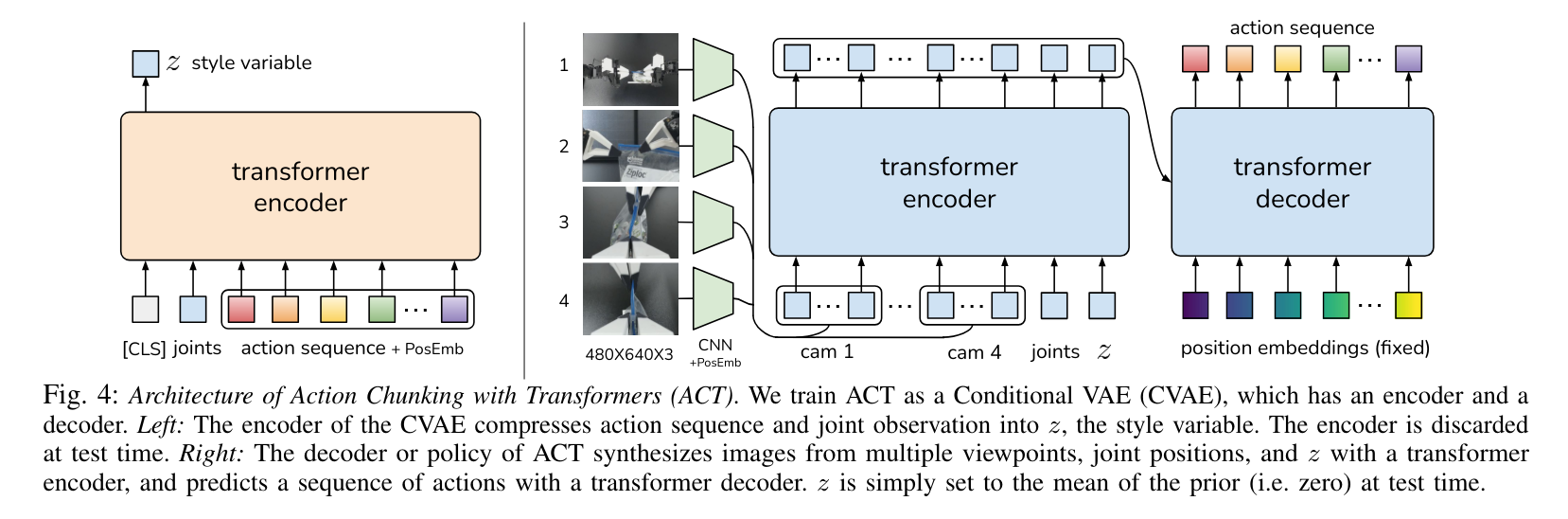
Figure 2 from Zhao et al. (2023). The CVAE encoder compresses image + joint state into a latent style variable z; the decoder takes z + the same inputs and predicts an action chunk. All the knobs live in configuration_act.py.
The experiment. Change chunk_size, keep everything else locked, and measure what happens to task success on PushT.
| Variable | chunk_size ∈ {16, 32, 100} |
|---|---|
| n_action_steps | matched to chunk_size (predict N → execute N → re-plan) |
| batch_size, seed, steps | 64, 1000, 20000 (locked) |
| Stack | huggingface/lerobot-gpu, torch 2.11, LeRobot 0.5.2, torchcodec-CPU |
The metrics. There are two that matter, and they disagree:
Per episode: the single best frame of T-block → goal overlap. 1.0 = perfect coverage, even if only for an instant.
Example: Episode 37 — max_reward 0.999, pc_success false. The T grazed the goal perfectly for one frame, then drifted away.
Per episode: did the block sustain coverage above the threshold long enough? Binary. Much stricter than max_reward ≈ 1.0.
Same episode 37: max_reward 0.999 but success = false. A one-frame graze doesn't count.
The gap between these two metrics is where the finding lives.
Matching
n_action_steps = chunk_size varies two things at once: (1) how far ahead the model learns to predict during training, and (2) how many actions are executed open-loop before re-planning during inference. A bigger chunk_size means the policy re-plans less often. This experiment measures the combined effect. Isolating them is a follow-up. Naming the confound is itself part of showing you understand what you're measuring.
The results
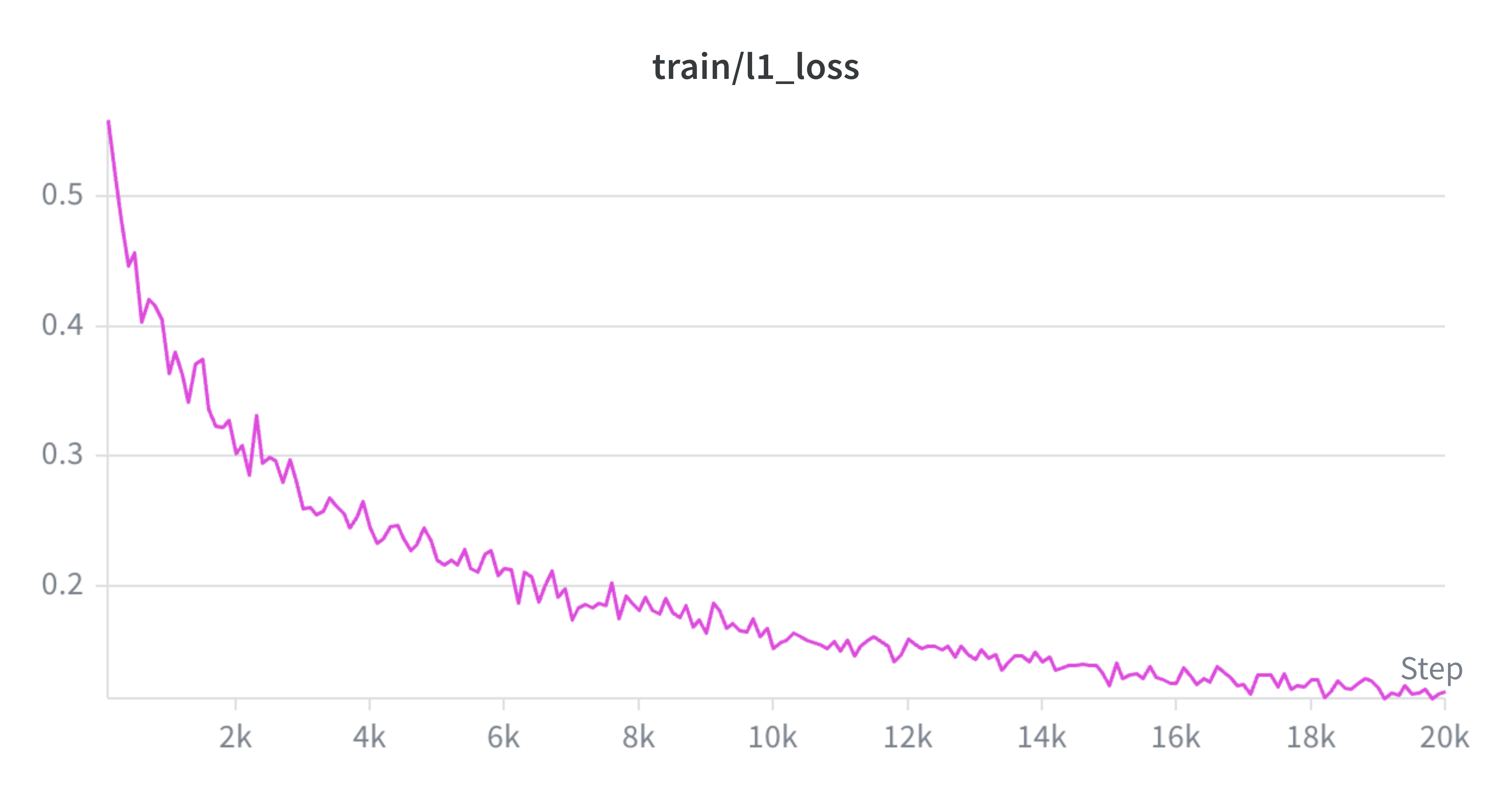
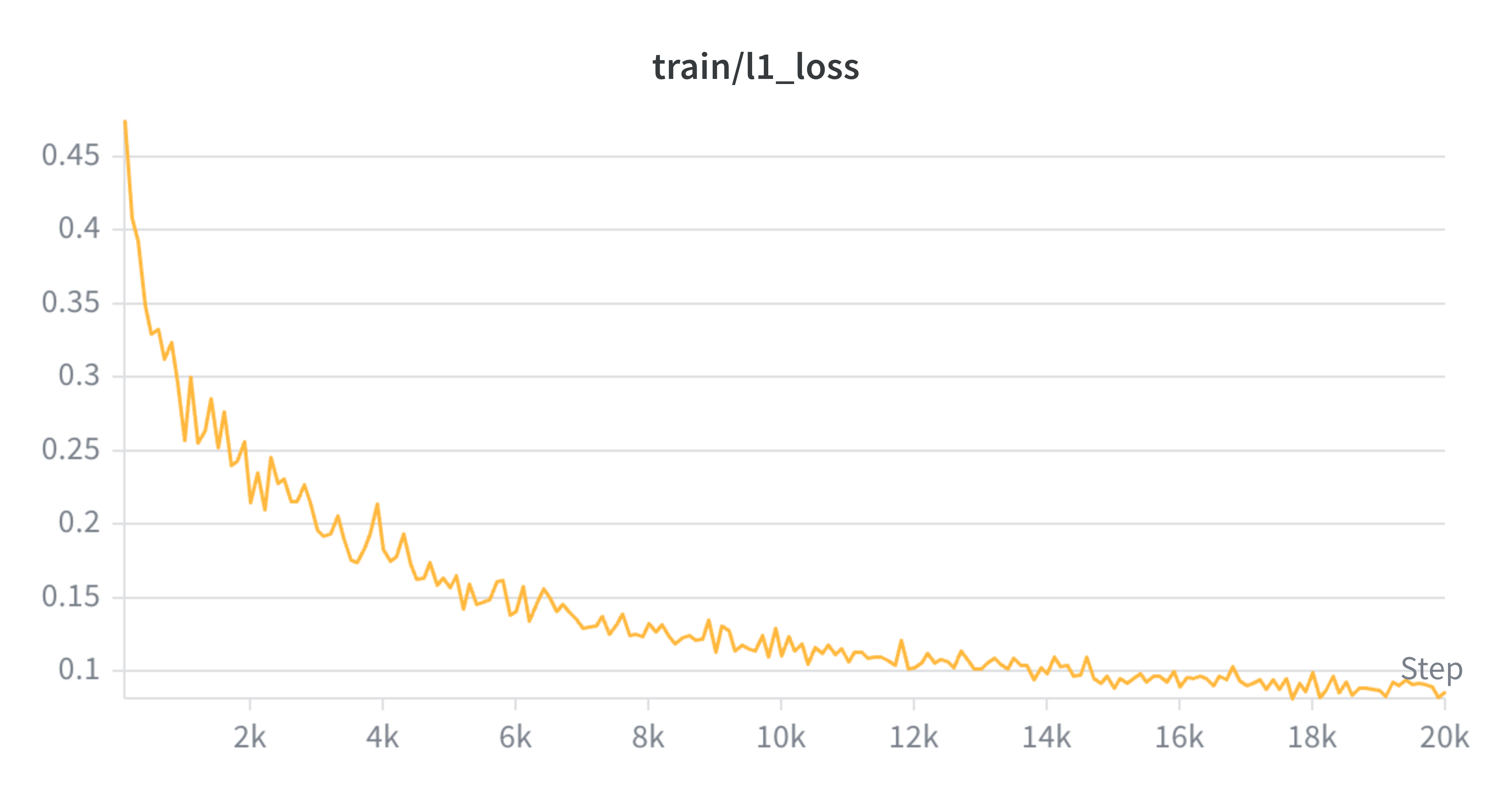
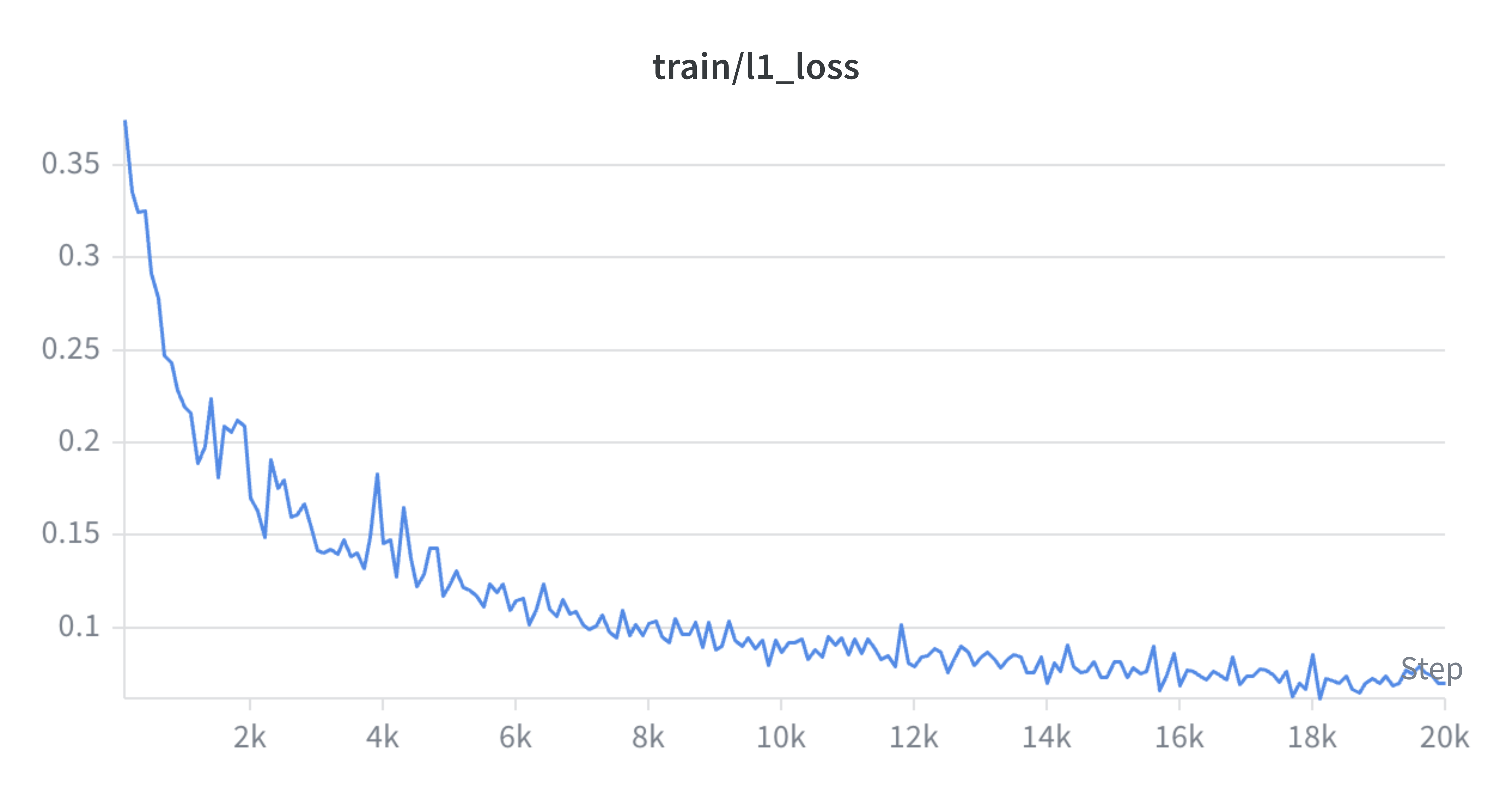
All three runs converged — the loss curves are stable by 20k steps. The result differences aren’t an undertraining artifact (with the caveat that chunk100 may need more steps — see Analysis).
| chunk_size | pc_success | avg_max_reward | avg_sum_reward |
|---|---|---|---|
| 16 | 14.0% (7/50) | 0.686 | 71.29 |
| 32 | 8.0% (4/50) | 0.706 | 79.15 |
| 100 | 0.0% (0/50) | 0.326 | 28.28 |
pc_success drops monotonically: 14% → 8% → 0%. Bigger chunks, worse success. Straightforward.
But avg_max_reward doesn’t follow the same curve. It peaks at chunk32: 0.706, higher than chunk16’s 0.686. The model that succeeded less often came closer to the goal on average. At chunk32, sum_reward is also highest (79.15), meaning the block spent the most cumulative time near the goal. Then both metrics collapse at chunk100 (avg_max 0.326, sum 28.28) — the block never really got close.
The chunk32 paradox. Watching the evaluation videos makes this concrete. The block approaches the goal smoothly and accurately — more fluid than chunk16, fewer jittery corrections. It lands on the target. Then, executing the tail of its 32-action chunk open-loop, it pushes the T away before the next re-plan fires. By the time it re-observes, the drift has already happened. It corrects, gets back near the goal, overshoots again. The approach is better. The sustained coverage is worse.
At chunk100, the policy re-plans only ~3 times across a 300-step episode. It executes 100 actions blind. The block drifts. It never recovers. Zero successes — it barely reaches the goal at all.
What it took to get here
This experiment is one command: lerobot-train ... --policy.chunk_size=16. It took seven dead ends and one falsified hypothesis before that command ran clean. Here are two that earned their spot in the write-up.
#1: I tried to move decode to the GPU — and proved myself wrong
During the first successful run, the GPU sat at ~90% idle. data_s — the time spent fetching the next batch from the dataloader — was ~0.44 seconds per training step. updt_s — the time spent computing the gradient — was ~0.037 seconds. The GPU was waiting on the CPU 12× longer than it was computing.
The natural diagnosis: the CPU video decoder is the bottleneck. Move video decode to the GPU (NVDEC). Feed frames directly to the GPU. Eliminate the data stall.
So I benchmarked it. PushT video, RTX PRO 4000, 500 random-index seeks:
| Decoder | Random-access fps | DataLoader data_s (median) |
|---|---|---|
| pyav (CPU) | — | 24.5 ms |
| torchcodec (CPU) | 50 | 0.4 ms |
| torchcodec (CUDA/NVDEC) | 7 | — |
Why random access kills video decoders
Frames: 0 → 1 → 2 → 3 → 4 → …
Decoder reads one GOP (Group of Pictures), decodes once, feeds frames in order. This is what video decoders are optimized for.
| CPU | 2,284 fps |
| NVDEC | 2,599 fps |
NVDEC wins slightly — streaming is its design target.
Frames: 347, 12, 891, 45, 632, …
Shuffled dataset → each seek jumps to a different GOP. Decoder must: (1) find nearest keyframe before target, (2) decode forward through intermediates, (3) discard them.
| pyav (CPU) | ~2 fps (est.) |
| torchcodec (CPU) | 50 fps |
| NVDEC | 7 fps |
NVDEC is 7× slower than CPU — per-seek GPU transfer overhead kills it.
Three things this table says:
-
The bottleneck was seeking, not decoding. CPU sequential decode does 2,284 fps. Random access drops to 50 fps — a ~45× penalty. The shuffled DataLoader asks for frames in arbitrary order. The cost is finding the right frame, not decoding it.
-
torchcodec-CPU was 60× faster than pyav in the real dataloader (0.4 ms vs 24.5 ms median). pyav seeks wastefully — it decodes from the last keyframe forward. torchcodec seeks frame-accurately. The fix was already the default; pyav was only in use because an earlier torchcodec mismatch had forced a fallback. Free.
-
NVDEC was 7× slower than CPU at random access (7 vs 50 fps). Per-seek overhead + per-frame GPU transfer kills it. NVDEC is built for streaming sequential frames, not seeking to random ones. The whole “move decode to GPU” hypothesis was wrong.
I’d built a mental model of the bottleneck, gathered the tools to fix it, and then measurement showed the premise was false. The fix wasn’t a hardware upgrade or a day of NVDEC configuration. It was changing one word in a CLI flag: pyav → torchcodec. The GPU had been sitting 90% idle because the default backend was fine all along — I’d just never let it run.
Measure the bottleneck before optimizing it.
#2: The tutorial didn’t mention these four flags
The LeRobot README says:
lerobot-train --dataset.repo_id=lerobot/pusht --policy.type=act
Four flags it does not mention, each of which crashed training before the first step:
--policy.push_to_hub=false. LeRobot defaults to pushing the model to Hugging Face Hub at the end of training. No repo configured → crash. Invisible if you have a Hub token set.
Check out a release tag, not main. GR00T’s policy config on main uses an older @strict API that’s incompatible with the current huggingface_hub. One policy you won’t use takes down the entire lerobot-train import. The fix: git checkout $(git describe --tags $(git rev-list --tags --max-count=1)).
--env_eval_freq=10000, not --eval_freq. LeRobot 0.5.2 renamed the sim-evaluation frequency flag. The old name errors with unrecognized arguments. The new name isn’t in the 0.5.2 changelog.
--eval.n_episodes=50, not less. Eval instantiates parallel environments equal to eval.batch_size (default 50). eval.n_episodes=30 → ParsingError. It refuses to create more envs than it uses.
Each is a one-line fix. Combined: four attempts before the training loop started. Tutorial commands assume the exact environment their author tested on — the same LeRobot commit, the same packages, the same flags. When any link in the chain is different, the command that “just works” doesn’t.
Analysis: what the numbers actually mean
The open-loop staleness tax. Every chunk_size increase, when n_action_steps is matched, reduces how often the policy re-observes the world. At chunk16 it re-plans ~19 times per 300-step episode. At chunk32: ~9 times. At chunk100: ~3 times. With fewer re-plans, drift from the stale prediction accumulates longer before correction. The tax grows faster than any benefit from a longer training horizon.
This explains the chunk32 paradox directly. chunk32’s approach trajectories are smoother (longer horizon = more coherent multi-step predictions). The block reaches the goal more accurately on average — hence the higher avg_max_reward (0.706). But the matched n_action_steps=32 means it commits to 32 actions blind. Near the goal, those tail-end actions push the block past the target before the next re-plan catches it. The approach is better; the sustained coverage is worse. chunk16 is twitchier but corrects faster.
The fixed-budget caveat. 20,000 training steps may under-serve chunk100. Longer action chunks are a harder prediction target — the model has to forecast further into the future — so it may simply need more steps to converge. The 0% success rate could be part open-loop staleness, part undertraining. A follow-up extending chunk100 to 40k+ steps would test this.
The single-seed answer. All three runs share seed=1000. The 14% → 8% → 0% direction is unambiguous — you don’t need statistics to see that chunk100 is worse than chunk16. But the exact percentages have seed noise. A multi-seed follow-up would tighten the confidence intervals.
What I’d do next
Isolate horizon from re-plan frequency. Fix n_action_steps=16 and vary chunk_size independently (16, 32, 100). This separates “how far ahead does the model learn to predict?” from “how often does it re-observe during inference?” If success still drops with bigger chunk_size even at fixed re-plan rate, the training horizon itself is the limiting factor — not the staleness.
Test whether chunk100 is undertrained. Extend chunk100 to 40k+ steps. If success rises, the 0% was a budget effect, not a horizon ceiling. If it stays at 0%, the open-loop staleness at matched n_action_steps=100 is fundamentally fatal.
Multi-seed. Three seeds per chunk_size to bound the variance.
Reproduce
Everything needed to reproduce this experiment is in the repository root:
- Setup:
lerobot-setup.sh— one-time pod configuration - Train:
scripts/train.sh <chunk_size>— launches training with the locked config - Eval:
scripts/eval.sh <chunk_size>— standalone evaluation on saved checkpoint - Configs:
configs/chunk{16,32,100}.yaml— per-run locked configuration - Results:
results/chunk{16,32,100}_eval.json— per-episode eval data
Environment: huggingface/lerobot-gpu@sha256:b0318f57aaab7d8204f5bd3c61bf98b4660c4240b546e60d6205e1d65035b9d2, torch 2.11, LeRobot 0.5.2, torchcodec 0.11.1+cpu, seed=1000, PushT, 20k steps.